At Blue Leaf, our school’s educational approach to curriculum is Contextual. Unlike prescribed, rigid curricula, contextual curriculum creates learning experiences and environments that are meaningful, relevant, engaging, and thought-provoking. By valuing the interests of the children and co-creating the curriculum, the learning within the classroom becomes democratic.
The Environment as the third teacher is a concept that originates from the Reggio Emilia approach to education. As the name implies, the environment is seen as the third teacher, along with the teachers, and the children. Our environmental surroundings have immense ability to shape the learning experiences one can encounter, discover, and create. As teachers, our job is to be in tune with the children’s interests, and in turn make sure our learning environment is capable of encouraging and expanding upon those interests. This includes, but is not limited to, the design of the space itself, the materials within it, and the senses appealed to. When the final teacher steps in (the child) they bring their own intentions, discoveries, and alterations to the environment. Therefore, the environment will never be stagnant. The nuances within the environment create ripple effects throughout the entire learning community. Our goal is to maintain a high quality learning environment that will promote high levels of engagement, research, and discovery.
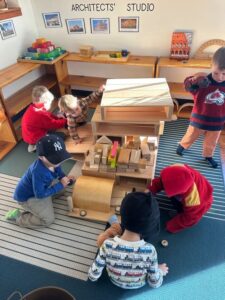
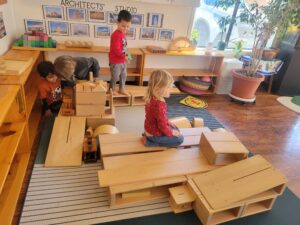
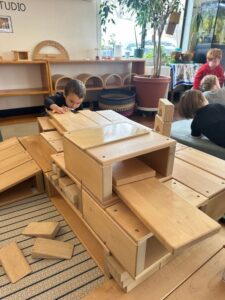
Since January, the children continued to show a strong interest in building with blocks. Each day, complex structures would be erected, from boats, to paths, to farms and more.
Questions about this work began to guide our research:
-Is the children’s interest only in building structures?
-How would the scale of materials change the resulting creations?
-How would they respond to other materials that could be “put together” to create or construct something?
-How can the environment be altered to reflect these interests?
Through provocations and small groups with beads and pipe cleaners, loose parts, popsicle sticks and glue, it became evident that the children’s interest was not just limited to the building of structures…Therefore, this work defined as building didn’t feel strong enough to capture the complexity of the work occurring. As new materials were offered it became evident that the children were doing so much more. Thus we began centering the work around construction.
As defined by Merriam-Webster, Construction is
1. the act or result of construing, interpreting, or explaining
2. the process, art, or manner of constructing something
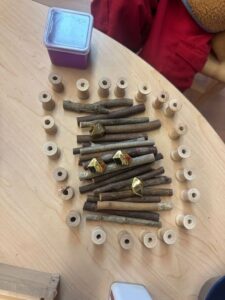
How could the environment be altered to reflect this interest?
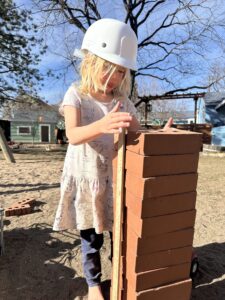
Our teaching team spent time enhancing the environment by adding a dedicated loose parts table in lower pre-k, offering new construction materials such as counting cubes, hexi snaps, wooden connectors, hard hats, safety glasses, bricks, concrete cylinders, and yard sticks.
“Not knowing is the condition that makes us continue to search; in this regard, we are in the same situation as the children. We can be sure that the children are ready to help us. They can help by offering us ideas, suggestions, problems, questions, clues, and paths to follow; and the more they trust us and see us as a resource, the more they give us help. All these offerings, merged with what we ourselves bring to the situation, make a handsome capital of resources”
(Malaguzzi, 2012, p 64)