
NOTES FROM THE DIRECTOR
“Children need both nurture and structure.
Love without limits is not enough, and limits without love are not enough.”
-Daniel Siegel
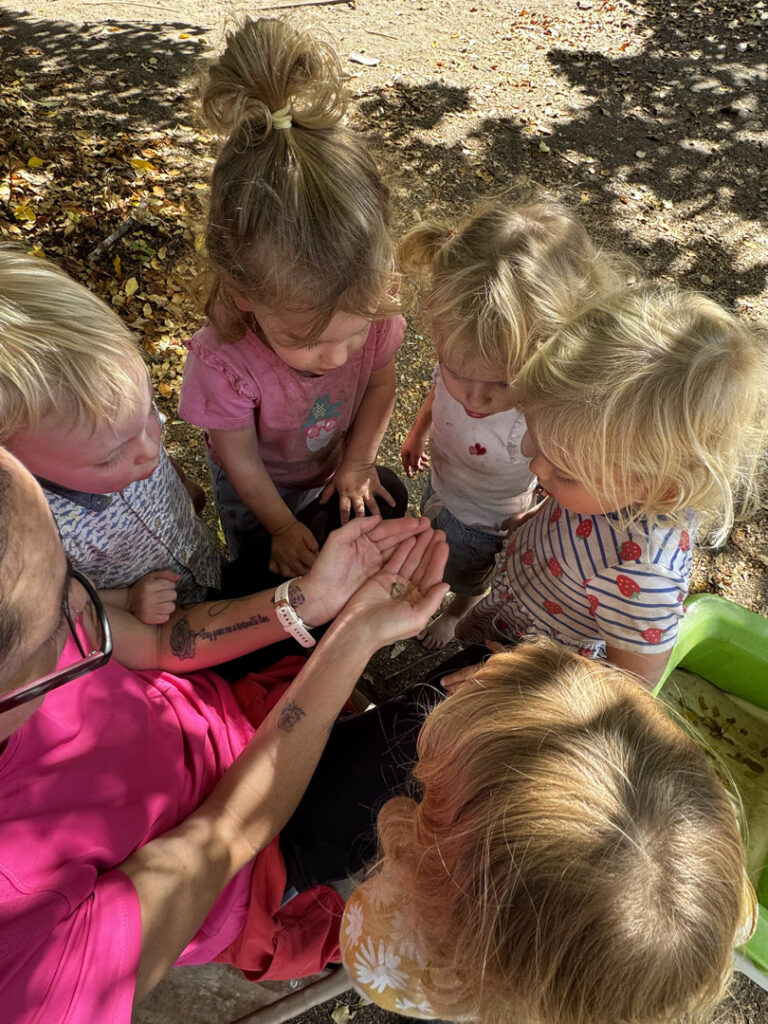
Boundaries as Love
One of the greatest gifts we can offer children is clear, respectful boundaries. In today’s world, the words “gentle parenting” are often misunderstood to mean saying “yes” to everything or avoiding limits to prevent upset feelings. At Blue Leaf, and within the RIE®
(Resources for Infant Educarers®) philosophy, we understand that respectful caregiving is not permissive caregiving. Children thrive when they know what is expected of them and can trust that the adults around them will lovingly hold those expectations. Magda
Gerber often reminded us that a “Lack of boundaries makes children feel unsafe.” Children are always looking to find where the boundary is and constantly asking, “Can I trust you to keep me safe? Will you help me know what is expected?” Every consistent
boundary answers those questions with a reassuring “yes.”
Some of the first boundaries children experience at Blue Leaf are around food and care routines. These help create the foundation for self-regulation and resilience. At Blue Leaf, we sit at the table while eating and drinking, drink from our water bottles at the
table, wash our hands before meals, wait for one another during mealtimes, and more. These routines are not arbitrary rules; they communicate safety, predictability, and respect for ourselves, for others, and for our environment.
Boundaries also communicate something incredibly important: you are worth protecting. When we consistently enforce a boundary with kindness, we tell children: “I will keep you safe; I know what you need; even when you don’t like it, I can handle your big feelings; our relationship is strong enough to withstand disappointment.” This is why RIE® educators remain calm and confident when children protest a limit. We do not shame children for their feelings, nor do we remove the boundary because the child is upset. Instead, we acknowledge their emotions while holding the expectation. “I hear that you want to keep playing. It’s time to wash our hands before lunch.” “You wish you could drink your water while you play. Water stays at the table.” Sometimes a simple “l hear you,” and a head nod is enough acknowledgment of their disappointment. The boundary stays, and the child is supported.
In RIE®, we strive to speak to children with honesty and respect. One way we do this is by avoiding questions when there is no actual choice. It is common to hear adults say: “It’s time to change your diaper, okay?” “It’s time to get in the car, okay?” Adding “okay?” at the end of a statement suggests that the child has the option to say “no.” If the expectation is non-negotiable, it can be confusing. Children are learning that words have meaning, and when we ask a question but don’t truly mean it as a question, we unintentionally undermine trust.
Magda Gerber encouraged adults to involve children as active participants in their own care rather than simply doing things to them. Caregiving routines become opportunities for collaboration, connection, and respect. Instead of asking whether the diaper change should happen, we might say: “It’s time to change your diaper. Would you like to crawl like a kitty to the changing table or stomp like a giant?” “Would you like the blue bib or the gray one?”
Another powerful way we communicate respectful leadership is through “I statements.” Instead of placing the responsibility on the child with phrases like “You need to stop hitting the dog” or “Don’t throw the blocks,” RIE® encourages adults to calmly state what they intend to do.
For example: “I am not going to let you hit the dog.” While putting your arm out to block the action. “I am going to move these blocks because they are being thrown.” “I am going to help keep your body safe.” “I won’t let you push her.” These statements are clear, honest descriptions of our responsibility. They communicate, “I am here, I am paying attention, and I will keep everyone safe.” “I statements” remove blame, invite connection, and emphasize our role as calm, capable leaders. Children do not need adults who simply tell them what not to do; they need adults who are willing to step in when necessary and confidently hold the boundary while providing the support and regulation that they are still developing.
At Blue Leaf, we believe that respectful relationships are built on both empathy and leadership. We welcome every emotion while confidently guiding behavior. We honor children’s competence while recognizing that they depend on adults to create the structure they cannot yet create for themselves. When children know the limits, they are free to explore, learn, and grow in a world that feels safe, predictable, and filled with loving adults who can lead with both kindness and confidence.