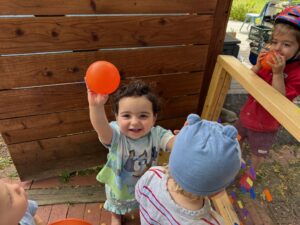
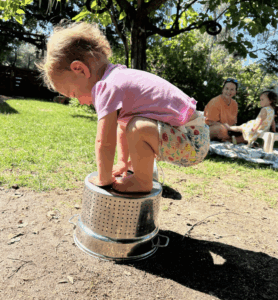
Recently, we’ve been noticing a theme in our toddler classroom: the children are going up. Climbing logs, onto stumps, into small spaces, testing their balance on unsteady surfaces; exploring what their bodies can do! They are carrying big rocks, throwing balls, and engaging in rough and tumble play! It’s exciting to watch, and, at times, it can make us feel a little nervous.
I’m aware of my own instinct to call out, “Be careful!” or “Woah, too high!” in those moments. While well-meaning, these phrases often do more to ease my anxiety as a teacher, than to support the child.
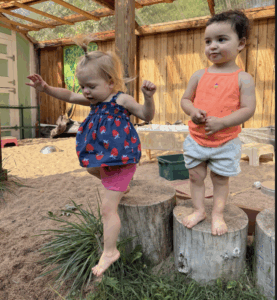
The other day, Jude climbed to the top of one of the stumps in the outdoor environment and was looking precariously balanced. A teacher nearby moved closer and went to ask how she felt. Before we could finish the question, Jude called out immediately, “I’m safe!” looked down, adjusted her footing, and spent some more time on the stump. It was a moment of self-awareness and self-trust for her, something we may have interrupted if we’d rushed to scoop her up.
In this post, I want to share why we limit our use of “be careful,” how it connects to our RIE approach, and what we’ve learned by observing toddlers take risks, solve problems, and trust themselves.
Why We Try Not to Say “Be Careful”
Defaulting to “be careful” often comes from our own anxiety, not the child’s actual need.
It is vague and doesn’t give the child specific information or guidance.
It often interrupts a child’s focus and creates unnecessary fear.
Repetitive use encourages the child to doubt their own abilities, relying on the adult to guide their next actions
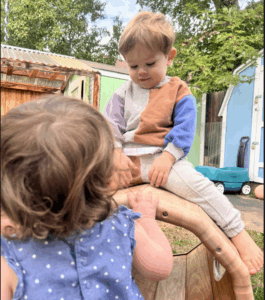
We’ve noticed the toddlers climbing outdoor structures, sitting atop the Pikler triangle, or scaling the balance beam. These are moments where we feel nervous, but we know that reacting automatically with “be careful!” doesn’t actually help them stay safe, it usually startles or distracts them.
 Toddlers Are Capable Risk-Takers
We view the toddlers in our classroom as competent and capable.
Risk-taking is a healthy and necessary part of development.
When children are allowed to explore physical challenges, they develop bodily awareness, problem-solving skills, and confidence.
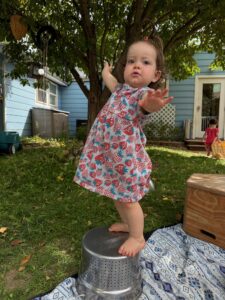
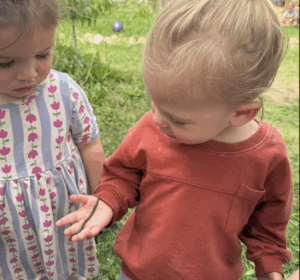
When we give toddlers time and space to assess a challenge, like a slippery patch of wet grass, we observe that they often pause, test the surface, look around, or even choose a different path. This shows they are thinking about safety in their own way.
What to Say Instead of “Be Careful”
As their teachers, we offer specific language to support awareness without instilling fear:
“Do you feel steady?”
“Notice where your feet are.”
“That rock is wet and might be slippery, what’s your plan?”
“I see you’re high up, how does your body feel?”
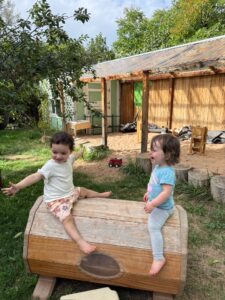
“You are testing your balance on that rocker, hold on tight!”
Try turning your anxiety into curiosity. You may not get a verbal response from your child, but you may be surprised at how much consideration they give to comments and inquiries like these!
Managing Our Own Fear
It’s OKAY to feel nervous, but how we respond matters.
Children look to their trusted adults for emotional regulation and trust cues.
A scared face and panicked voice signals to the child that they’re unsafe, even if they’re in control of the situation.
We sometimes take a deep breath before responding. We may step closer silently to be in proximity, or simply observe. Being present is often more helpful than intervening physically. When we do intervene (catching a falling child, helping someone down who is truly stuck, etc), we let them know why we stepped in, and what they can do in the future to protect their own bodies.
Encouraging Safe Risk Through Observation
In the teaching philosophies we practice, observation is central.
By closely watching how a child moves and responds, we build trust and engage in their decision-making.
We learn when to step in and when to step back.
Some toddlers act slowly, methodically checking each step. Others move quickly, but stop and adjust when something feels off. These actions show self-regulation at work.
Building a Culture of Trust
When we avoid defaulting to fear-based language, we build mutual trust.
Children begin to trust their bodies and trust us to support their exploration, not limit it.
It shifts our role from “protector from all risk” to “partner in exploration.”
Language Shapes Perception
The words we use shape how children think about themselves.
“You need to be careful” → cautious identity.
“You’re strong and paying attention to your body” → capable identity.